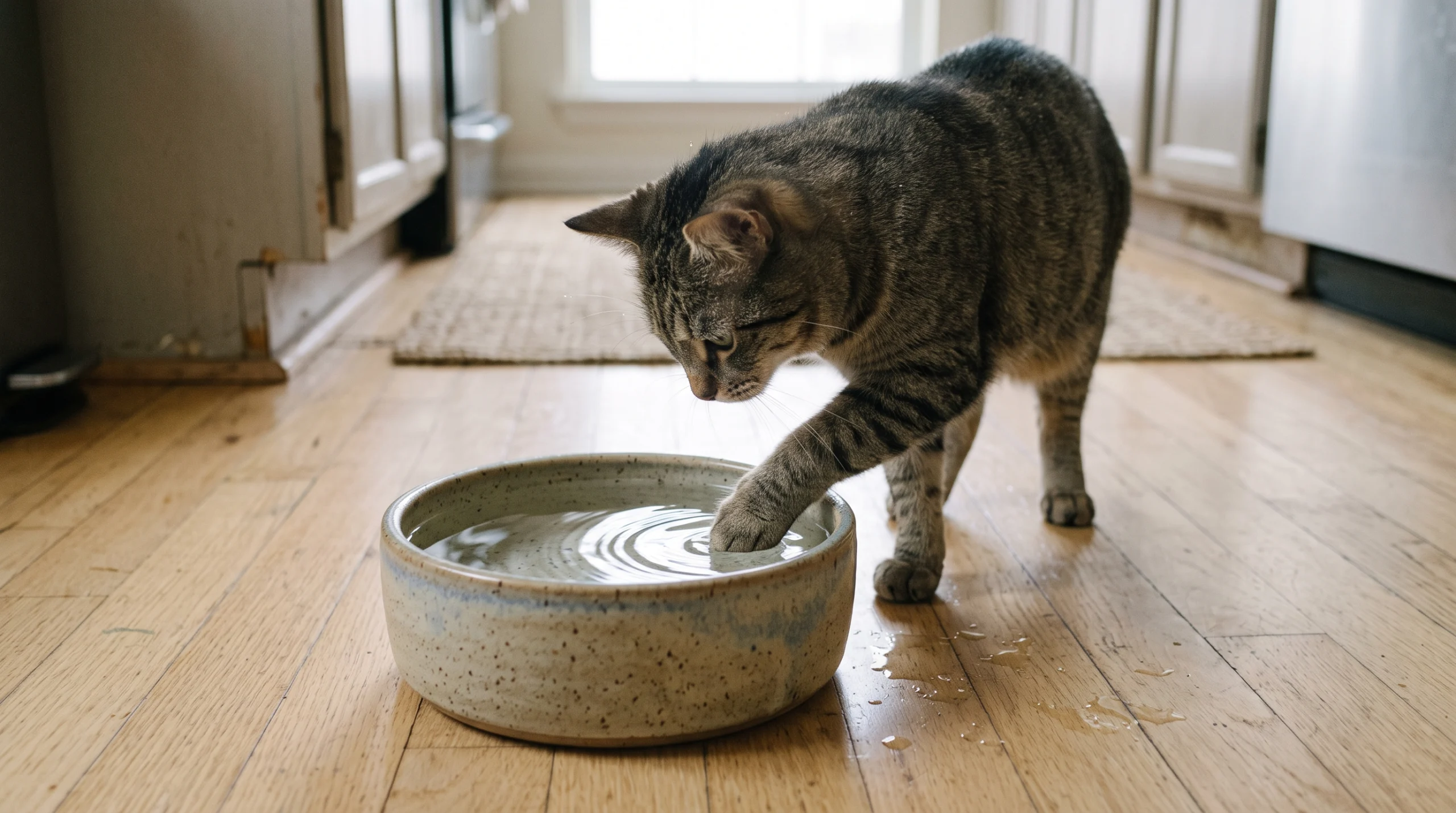
If you constantly find puddles surrounding your cat’s hydration station, you are not alone. While it may look like random mischief or defiance, tipping over a water dish is almost always an instinctual reaction to how cats perceive their environment, see water, or feel discomfort while drinking.
1. Whisker Fatigue: The Silent Discomfort
A cat’s whiskers (vibrissae) are not simply facial hair; they are deeply rooted sensory organs packed with nerve endings. These tactile hairs detect microscopic air currents, navigate tight spaces, and gauge physical boundaries.
When a cat drinks from a deep, narrow dish, their whiskers brush repeatedly against the ceramic or plastic rim. Over time, this constant contact sends a barrage of sensory signals to the brain, causing a condition known as whisker stress or whisker fatigue.
- The Tipping Reaction: To avoid painful sensory overload, cats often paw at the edge of the bowl to splash water onto the floor or tip the dish over so they can lap up water flat against the ground without whisker friction.
- The Solution: Switch to shallow, saucer-style dishes with wide circumferences (at least 6 inches across) so whiskers remain completely untouched during sips.
2. Poor Near-Focus Depth Perception
Feline vision evolved for tracking fast-moving prey at medium-to-long distances in low light. Up close (under 10 inches), a cat’s visual acuity drops significantly, and their eyes struggle to focus on small details.
Because completely still water inside a clean bowl is clear and transparent, cats often cannot see where the surface begins. Sticking their face straight into the dish risks accidentally submerging their sensitive nostrils.
To test where the liquid begins, cats will:
- Paw the side of the bowl to create ripples.
- Bat the base until water sloshes and catches ambient room light.
- Dip one paw into the center and lick the droplets off their fur.
If the bowl is lightweight, these test taps quickly turn into full spills.
3. Stagnant Water Triggers Survival Instincts
In the wild, felines instinctively avoid standing, stagnant puddles because motionless water frequently harbors bacteria, parasites, and decaying organic matter. Moving rivers and bubbling streams, by contrast, signal clean, oxygenated water.
When domestic cats encounter completely still water sitting in a bowl for several days, evolutionary instinct urges them to “activate” it. By knocking or clawing at the bowl, they attempt to create water flow. This is also why many cats ignore their water dish entirely and jump onto bathroom counters to drink directly from a dripping tap.
4. Territory Placement: The Food and Litter Proximity Mistake
Where you place your cat’s water dish matters just as much as what dish you use. In nature, wild predators never drink adjacent to their kill site to avoid contaminating fresh water sources with blood or digestive bacteria.
Placing a water bowl directly beside a dry food dish, or within sight of a litter box, can trigger stress. A cat may claw around the floor or shove the bowl away to create physical distance between their water and their food or waste.
Optimal Hydration Station Placement:
- Keep water dishes at least 3 to 5 feet away from food bowls.
- Place water in a quiet, low-traffic zone away from noisy appliances (like washing machines).
- Never locate water within the same room or line-of-sight as litter trays.
How to Stop Your Cat From Knocking Over Water (Step-by-Step)
You don’t need to accept wet floorboards as part of cat ownership. Implementing these practical adjustments will address the root cause of the behavior:
Step 1: Upgrade to a Weighted, Wide-Base Bowl
Lightweight plastic and thin stainless bowls tip over under minimal paw pressure. Replace them with heavy ceramic, stoneware, or non-skid silicone-ringed bowls that have a wider base than their top opening. A heavy, broad-bottom dish makes physical flipping virtually impossible.
Step 2: Introduce a Circulating Water Fountain
A quiet pet water fountain with a submersible pump provides continuous water movement. This completely solves the depth perception issue (cats can hear and see the flowing current) and satisfies their natural instinct for running water, removing their desire to paw at the dish.
Step 3: Use a Food-Grade Waterproof Silicone Mat
While training your cat and transitioning hardware, place a high-lipped silicone tray underneath the hydration zone. Choose a mat with a raised outer lip (at least 0.5 inches high) to catch any stray droplets and protect hardwood or laminate floors from warping.
Frequently Asked Questions
Why does my cat scratch the floor around their water bowl?
Scratching around the bowl—often looking like an attempt to bury it—is a scent-marking behavior. Cats have scent glands in their paw pads; kneading or scratching around their water asserts territorial ownership over the resource, especially in multi-pet households.
Does tipping water bowls mean my cat is bored?
Yes, playful paws can cause spills. If a cat lacks mental stimulation, scratching or slapping water creates ripples and reflections that act like an interactive toy. Introducing 15 minutes of interactive playtime with a teaser wand each day often reduces water-slapping habits.
Why does my cat only drink water with their paw?
Dipping paws into water is usually a direct symptom of whisker fatigue. By dipping and licking, the cat avoids touching their sensitive whiskers against the high sides of an uncomfortable bowl.